
“Bill Sloat, a long-time Fox Hollow resident loved this spot and dreamed of a bench here so cyclists and others could enjoy it too. Placed by family and friends of William R. Sloat with permission of the Dale Smith family, owners of this land. 1991.”
At almost any public park, you are likely to stumble across a bench with a memorial placard honoring a loved one. Memorial benches are not a new phenomenon. We have long found ways to extend structures beyond their form, giving them meaning through the lives of others.
Ancient Egyptians constructed obelisks, monolithic stone structures with a rectangular base and a pyramidal top. Obelisks were meant to honor Egyptian gods. Placed in large public spaces, obelisks provided citizens with a place for altar offerings. While it was uncommon for an average Egyptian to sit around an obelisk, smaller structures were erected to honor the piety of Egyptian pharaohs. Stone seats were built alongside these structures, providing citizens with a place to sit and reflect on the accomplishments of the honored.
In Ancient Rome, curved, semicircular marble seats called exedra were placed along busy roads and built as funerary monuments to loved ones, their names inscribed on the foot of each seat. Travelers would often stop on exedrae to rest, and it was a tradition to read the name of the deceased as the Romans believed this kept the spirit of the dead alive.
The Renaissance brought forth an emphasis on individualism, reshaping commemoration practices. Large churchyard memorials, gravestones, and tombs became commonplace among aristocratic families. This period represented a shift towards personal remembrance for families; however, it retained an element of privatization, as these structures were largely unaffordable for ordinary citizens.
Accessibility began to change with the modern public park movement of the 19th century. The public park movement in the U.S. was largely pioneered by Frederick Law Olmsted, who pushed for the construction of Central Park to improve urban life by combating congestion and social inequality. He believed natural beauty in urban spaces could soothe the mind and improve both mental and physical health.
Central Park’s success ignited the American public park movement as city planners across the country sought to create large urban green spaces. Benches were often placed along walkways and overlooks in these parks, offering visitors a place to observe local greenery while escaping the bustle of urban life.
World War I coincided with the public park movement, deeply impacting families and communities who were left to mourn loved ones whose bodies had often not been recovered. Families sought new ways to honor fallen soldiers, turning to bench placards as tangible, intimate tributes. Placards were placed on benches in cherished park locations or town squares, acting as a turning point in modern remembrance. Remembrance was no longer focused on grand commemorative structures for kings, generals, and gods. Instead, it emphasized sincere memorials for a daughter, father, grandparent, friend who loved to sit in a park, or a soldier who never returned from combat.
The Ruth Bascom Riverbank Path System in Eugene, Oregon, features these subtle tributes on nearly every bench. An observant bike ride or walk along the path west of the Willamette River reveals the quiet intimacy of memorial benches.

“Sela beautiful daughter and loving wife
true friend your sunshine smiles on everyone
a sister immortalized by wit and compassion”

“John & Dorothy Tusek 1920-2012 Rested here.
In loving memory of the many miles traveled
and walked during their 70 years together.”

“In Loving Memory of Jonathan L. Schive
Who taught us that we should be patient and
quiet enough to hear the story.”
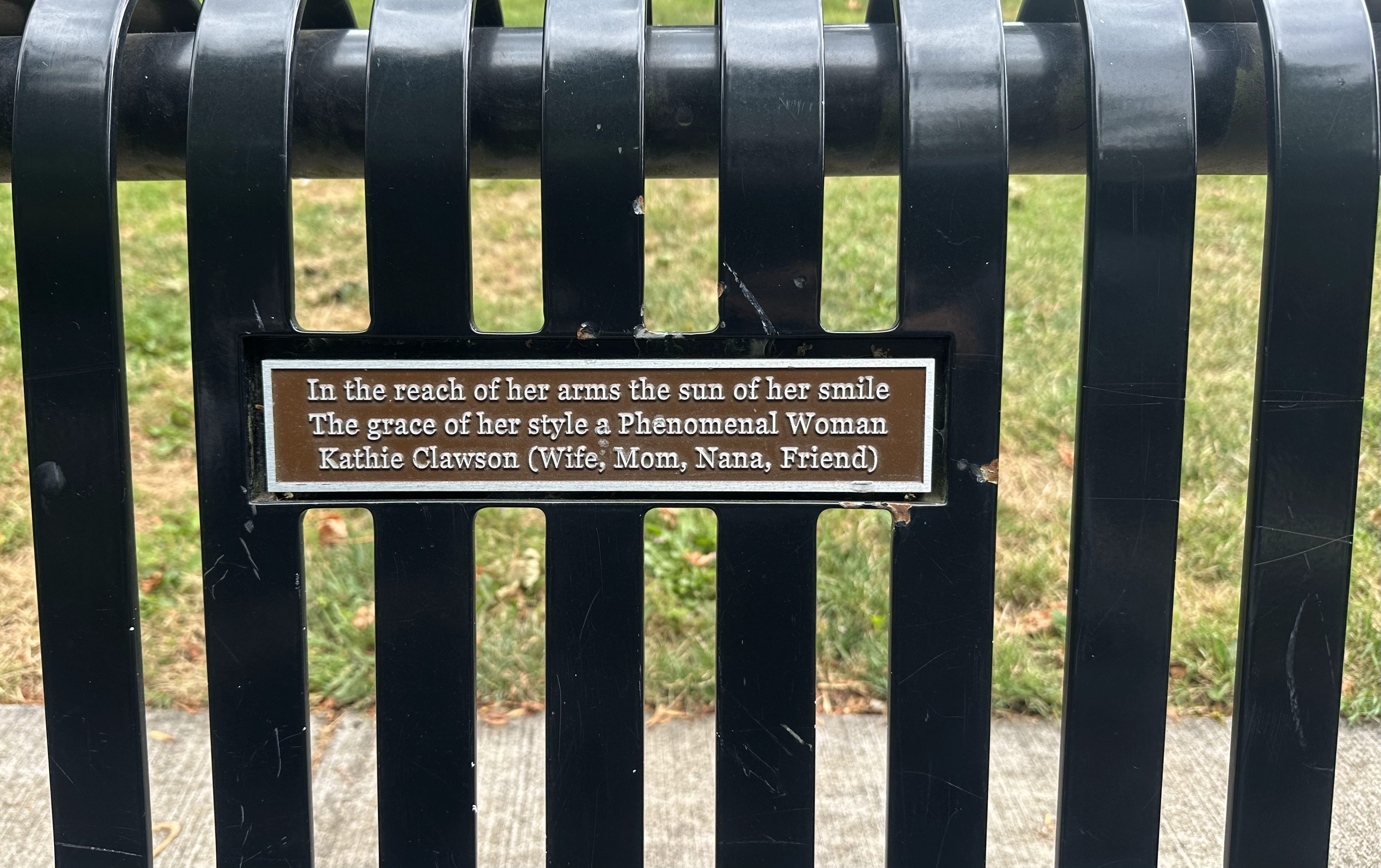
“In the reach of her arms the sun of her smile
The grave of her style a Phenomenal Woman
Kathie Clawson (Wife, Mom, Nana, Friend)”

“Jason Blake Keuter
Septermber 1967 – January 2017
Lest We Forget Icarus Also Flew”

“In memory of Nathan Crow, an unforgettable
person. May you find joy and peace along
this river, as he did.”
It is special to read the story of someone who walked along the same path as you, stopped to look at the same river, and sat in the same grass. In this way, memorial placards do more than assist a family in grieving and honoring a loved one; they offer strangers an opportunity to reflect on their life through the lens of another.
When thinking of why these tributes are so powerful, the final two placards are particularly resonant with me. There is an element of personality embedded in the memorial for Jason Blake Keuter. The line “Lest we forget Icarus also flew” references Jack Gilbert’s poem, “Failing and Flying.”
“Everyone forgets that Icarus also flew.
It’s the same when love comes to an end,
or the marriage fails and people say
they knew it was a mistake, that everybody
said it would never work…
I believe Icarus was not failing as he fell,
but just coming to the end of his triumph.”
Keuter’s family chose to honor him by reminding readers that his passing represented the end of his triumph. It is a reminder to remember the accomplishments encased in a life lived. When I first read this placard, I sat with it for a minute and allowed myself to think about the moments in my own life when I managed to fly in the first place, even though I may have fallen. The power of reflection, nested within a small memorial, reveals deep intimacy.
Nathan Crow’s memorial sticks out to me as well. “May you find joy and peace along this river, as he did.” There is comfort in knowing that someone else sought out this same path in moments of heaviness. In knowing that the river offered him what it offers me. Grief and struggle have a way of making our problems feel singular and immovable, but Nathan Crow’s bench is a reminder that others have carried their weight here, too, and found peace. In the grander scope of lives lived and lost, my troubles feel smaller and more temporary, simply because I stopped to read a placard on a bench.
The evolution of remembrance has long shaped how we grieve, culminating in something as simple and profound as a bench with a small plaque. These memorials endure because they mean something different to every person who stops to read them. Different observers, at different moments in their lives, bring their own joys and burdens to whatever tribute they stumble upon. For families, a memorial bench is a deeply personal tribute to someone loved and lost. For strangers, it is an unexpected gift. A brief window into another life that illuminates their own. Sometimes all it takes is a moment of stillness on a bench to remember that we are all still learning to fly.
Sources:
https://poets.org/poem/failing-and-flying
https://thecharmingbenchcompany.com/blogs/news/the-history-evolution-of-memorial-benches
https://sk.sagepub.com/ency/edvol/environment/chpt/urban-parks-movement#_